
The Music Industry Instagram Guide: comment funnels, DM automation and scheduling that convert
How comment-to-DM funnels, ice breakers and scheduling work on Instagram's official API, and how artists and labels turn posts into fans on their list.
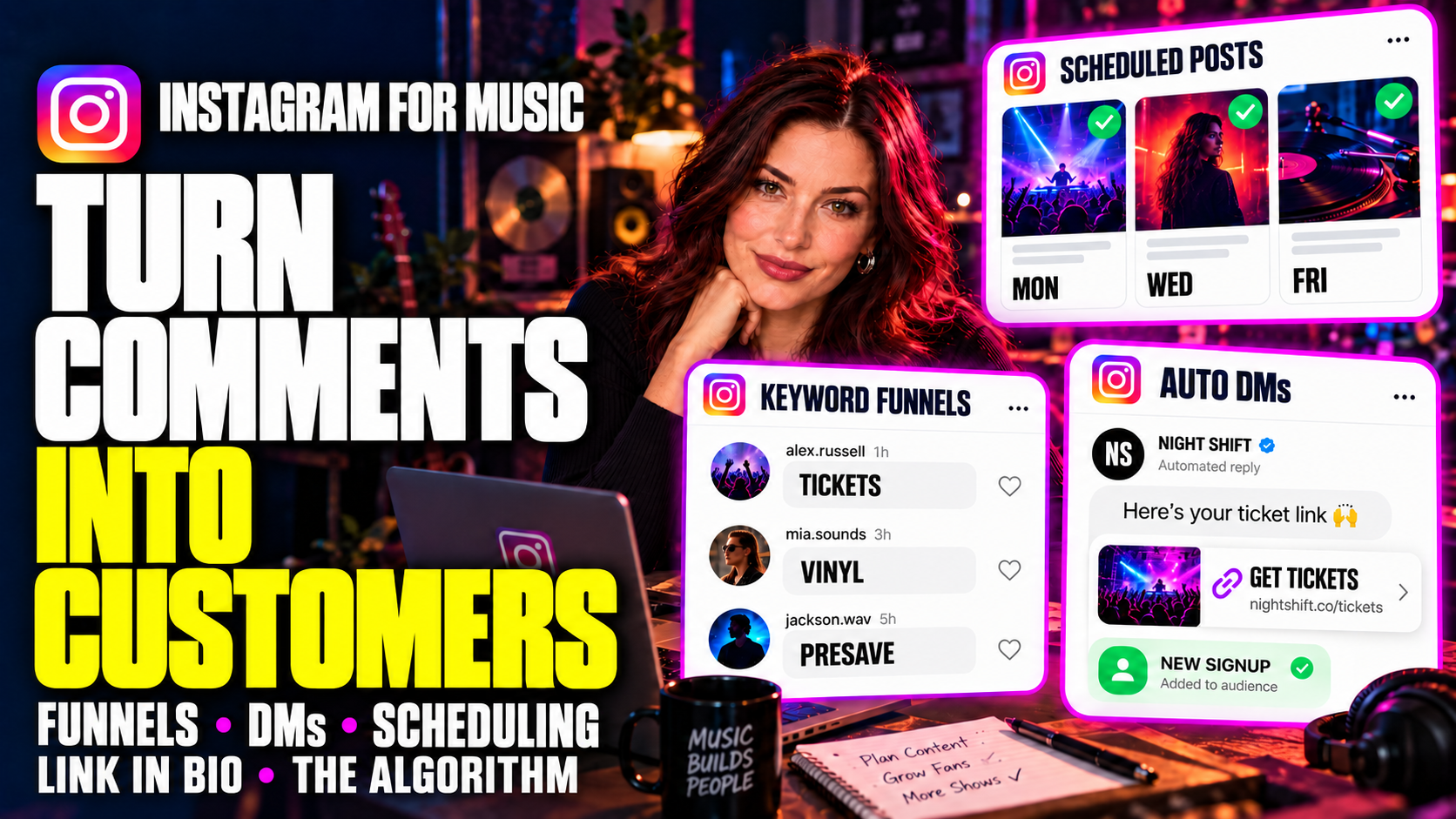
TL;DR
- The median Instagram post is engaged with by 0.30% of an account's followers, down from 0.36% a year earlier (Rival IQ, 2026). A follower count is not an audience, and a post is not a message to your fans. Treat Instagram as a capture channel, not a broadcast channel.
- Instagram's head, Adam Mosseri, names watch time, likes per reach and sends per reach (people sharing your post by DM) as the signals that matter most. Comment-to-DM funnels earn their keep by removing friction first; the ranking help is real but secondary.
- A comment-to-DM funnel is simple: a fan comments a keyword on your post, an automation sends them the link in a private reply, and they never have to hunt through your bio. Meta allows one private reply per comment, within seven days.
- Automation must run on Instagram's official API. Tools that log in with your password break Instagram's terms and put the account itself at risk. No link is worth losing ten years of followers.
- A DM is not a mailing list. A fan who messages you has given you a conversation, not permission to email or text them; ask for the address in the chat, and get the separate yes the law requires.
- The working playbook: keyword funnels on announcement posts (and giveaways run by the rules), ice breakers that make the first message a single tap, auto-replies for the questions you answer every day, story CTAs, a posting cadence you can sustain, and insights read for behaviour rather than applause.
Why does Instagram still matter when hardly anyone sees your posts?
Because it is where music fans already are, and because the fans it hides from you can be captured one at a time. Ofcom's Online Nation 2025 found Instagram in use by 78% of UK online adults, for about 20 minutes a day. But the median post is engaged with by 0.30% of the account's followers (Rival IQ, 2026), so a post to 10,000 followers typically draws about 30 likes and comments. That is not a reason to quit the channel. It is a reason to stop treating posts as announcements and start treating them as the top of a funnel. And the fans who matter most are there: no public study measures music discovery on Instagram in the UK, but in the US a 2026 study Meta commissioned from Luminate found 58% of music superfans use Instagram to engage with artists.
Here is the shift. A post that reaches 5% of your followers is a bad newsletter. But a post that gets 40 people to comment a keyword, each of whom is sent your ticket link by DM to a page that asks for their email, is a good capture machine. The first model depends on reach you do not control. The second converts whatever reach you get into contacts you keep.
There is also a structural reason conversation matters, set out in the mechanics below: what people watch to the end and send to a friend travels, and the messages a fan exchanges with you shape how much of you they see next. Content people politely scroll past does not.
So the honest position for anyone in music is this: Instagram is a discovery and conversation channel with weak broadcast mechanics. Play to what it rewards (watching, sharing, conversation), and use every burst of attention to move fans onto channels you control (email, SMS, WhatsApp). This guide is the manual for doing exactly that.
What most people get wrong on Instagram
Most accounts fail on Instagram for the same handful of reasons, and none of them is "the algorithm hates me."
Posting like a noticeboard. Artwork, date, "link in bio", silence. A post with no reason to watch to the end, send to a mate or reply gives the ranking nothing to work with. You are shipping content that is easy to scroll past and then blaming the distribution.
Sending everyone to a crowded bio link. "Link in bio" adds a step, and every step loses people. A fan on the sofa at 11pm will not tap your profile, find the right link among eight, and complete a checkout. The link needs to come to them.
Answering the same DM fifty times. Stage times, ticket links, guest list, "is it sold out". Every promoter and artist answers these by hand on show week, usually late, usually from a phone, usually while doing four other jobs. Slow replies lose sales, and they lose them silently.
Using password-based bots. Tools that automate likes, follows or DMs by logging into your account are against Instagram's terms. Accounts using them risk restrictions and bans, and a music account is often the single most valuable audience asset its owner has. This is the one mistake in this list you cannot undo.
Confusing applause with results. Likes and follower counts are the two numbers Instagram shows most prominently. Likes feed the ranking, but neither pays a pressing plant invoice. If you are not tracking comments, DMs, link taps and captured contacts, you are reading the scoreboard of a different game.
Treating Instagram as the destination. The account is rented land. Reach is variable, rules change, accounts get compromised. Fans only become yours when they land somewhere you control.
How Instagram actually works (the mechanics most guides skip)
What does the algorithm actually reward?
Ranking on Instagram is a set of predictions about what each viewer will do next, and not every prediction weighs the same. Mosseri's own summary, from January 2025, covers followers and non-followers alike: "the top three signals that matter most for ranking are watch time, likes and sends", read in your insights as average watch time, likes per reach and sends per reach, with likes slightly more important among followers and sends slightly more important with people who don't follow you yet. Meta's published system cards fill in the rest. Feed predicts whether you will share a post by DM, Reels predicts whether you will watch further than most people do, reshare, follow the author and use the reel's audio in a reel of your own, and Stories are ranked partly on the messages exchanged between the viewer and the account.
Two things follow for musicians. A reel built to be watched to the end and sent to one mate who was at the gig is working with the ranking, not against it. And your track is itself a signal: Reels ranking predicts whether a viewer will use your audio, which is how a sound spreads. Comments and DMs count too, just not at the top: commenting is one of the five interactions Instagram said in 2023 that Feed weighs most closely, and messages exchanged feed the Stories order. That is why a comment funnel helps the ranking a little and the fan a lot.
The one-link problem, and what changed
For most of Instagram's history you had exactly one clickable link, in your bio. Story link stickers reached every account in October 2021, and bios have taken up to five links since April 2023 (20 on Meta's paid Meta One plan, since September 2026). That helps, but the core problem stands: feed posts and reels have no tappable links, and "link in bio" asks the fan to leave the post, visit your profile and hunt. Every fan who does not bother is a lost click you never see.
Two mechanics route around it. Story link stickers put a real link inside a story. And DMs put a real link inside a private message, which is where comment-to-DM funnels come in.
The music tools built into Instagram
Instagram has more music machinery than most artists use, and most of it is free:
- The audio page. When a reel uses your released track, Instagram credits the artist and song and adds the reel to that track's audio page, where "Use audio" puts it in the next fan's reel. Your distributor is what gets a release into Instagram's music library, so check Facebook and Instagram are ticked in its store list.
- A song on your profile. Since August 2024 you can pin a clip of a track to your bio, and tapping it opens the reels using that song. Change it every release.
- Spotify's share sticker. Since August 2025, sharing a Spotify track to your story carries a short audio preview, and fans can save a song to Spotify straight from its Instagram audio page.
- Post reminders. A professional account can post about an event up to three months ahead; fans who opt in are notified a day before, 15 minutes before and at the start. Built for on-sales and show nights.
- Collab posts and reposts. A collab post (up to five collaborators) is shared with every collaborator's followers, which is why the artist, the venue and the label should co-post an announcement. Since August 2025, a fan's repost of your reel may be recommended to their followers too.
What is a comment-to-DM funnel?
A comment-to-DM funnel is an automation where a fan comments a keyword on your post (say "LINK" or "TICKETS"), and your account automatically sends them the relevant link in a private message. One clean definition, three effects:
- The fan gets the link without leaving the app or hunting through your bio. Friction drops, clicks go up. This is most of the value.
- The thread fills up. Commenting is one of the interactions Feed ranking weighs most closely, and later commenters see a wall of "TICKETS", which is social proof doing your job for you.
- The DM opens a private conversation between you and that fan. Meta's own documentation says Stories are ranked partly on the messages a viewer has exchanged with an account, so the fan who messaged you is likelier to see your next stories near the front of the tray.
Is a keyword post engagement bait? On Facebook, yes: Meta names "comment baiting" (asking people to comment specific words) and says posts that use it should expect less reach. Instagram's recommendation guidelines listed engagement bait until early 2025 and no longer do, and Meta builds comment-to-message automation into its own business tools, so nothing Instagram publishes today says a keyword that gets the fan something costs you reach. Meta still reserves the right to reduce engagement bait on either app, so keep the ask genuine, and keep two lines absolute: the DM must actually arrive (Meta's developer policies count a promised experience that never turns up as spam), and never trade money for comments, which Instagram's community guidelines forbid outright.
The 24-hour window, and why you cannot just DM everyone
Instagram's messaging rules are built around one principle: businesses reply, they do not cold-call. When a fan DMs your professional account, a 24-hour window opens in which you (or your automation) can reply freely. Outside that window, you cannot simply start a conversation. Comments have their own mechanism, the private reply: one message per comment, within seven days of it being left, and nothing more unless the fan replies, which opens the usual 24 hours. That private reply is the machinery behind every comment-to-DM funnel.
In practice:
- You cannot bulk-DM your followers, and no legitimate tool will offer it. Anyone promising cold DM blasts is risking your account. The one sanctioned broadcast is a broadcast channel, which fans choose to join: open to public accounts with more than 1,000 followers as it rolls out, and only members get the later messages.
- Automation is reactive by design. It fires when a fan acts: a comment, a DM, a story reply. A follow is not one of those actions, so no legitimate tool can message someone just because they followed you. Your job is to invite the action.
- Speed matters. The window opens when the fan engages, so automation's value is a reply that lands in seconds, at 11pm on a Friday, while the fan still cares.
One more mechanic worth knowing: unlike WhatsApp, where Meta charges for each marketing template message it delivers, Instagram's messaging API carries no per-message fees. The constraint is rules, not cost.
From a DM to your list: the separate yes
A fan who messages you has given you a conversation, not a marketing list entry. In the UK, emailing or texting someone marketing needs their consent, or, for your own customers, the "soft opt-in" (PECR, regulation 22), and a DM thread is neither. So the funnel's second job is to ask: a reply that says "want the next date before it goes public? Send me your email", or a link to a page with a proper signup. The answer is an address; the yes is what lets you use it.
The United States version. The rules run the other way round for email and tighter for text. CAN-SPAM needs no prior consent to send marketing email, only a working unsubscribe and a postal address, but the TCPA requires prior express written consent before a marketing text, and every unconsented message can be sued over. A US fan's email from a DM is usable with care; their number is not, until they have agreed in writing.
Official API or nothing
There are two kinds of Instagram automation tools. Official ones connect to your professional account through Meta's approved apps and API, operate inside the messaging rules above, and are reviewed by Meta. Unofficial ones automate a logged-in session with your password, and Instagram's terms of use forbid both halves of that: "accessing or collecting information in an automated way without our express permission", and collecting other people's Instagram passwords. Accounts caught doing it face restrictions and bans.
The test is simple: if a tool asks for your Instagram password, close the tab. If it connects through the official Meta authorisation screen, it is playing by the rules. You also need a professional account (business or creator); personal accounts cannot use the messaging API at all. For an artist, pick creator: Meta positions creator accounts for artists, and certain business accounts lose the licensed music library for reels and stories, leaving Meta's royalty-free Sound Collection. Labels, venues and promoters fit business.
The playbook: six moves that turn Instagram into a capture channel
1. Put a keyword funnel on every announcement post
Any post that exists to drive an action (release out now, tickets on sale, merch drop, pre-order live) gets a keyword CTA in the caption: "Comment LINK and I'll send it straight to your DMs." The automation replies publicly ("Sent! Check your DMs") and delivers the link privately.
Rules of thumb from watching these run:
- One keyword per post, in caps, short and obvious. TICKETS, LINK, VINYL, PRESAVE. Do not make fans guess.
- Say explicitly what happens: "comment TICKETS and the link lands in your DMs." Fans hesitate when the mechanic is unclear.
- Make the DM more than a bare URL. Two lines of voice ("Here it is. First 100 get the early price.") outperform a naked link.
- Pin a comment with the same CTA so latecomers see it above the noise.
- Repeat the mechanic across the campaign. Fans learn it. By your third drop, commenting the keyword is a habit.
The same mechanic runs a giveaway ("comment WIN to enter"), and a giveaway comes with rules. In the UK a prize draw must be free to enter, and the advertising code expects the terms up front: the closing date, the prize, who can enter, and how and when the winner is picked and told (CAP Code, section 8). Instagram's own promotion guidelines add two lines your terms must carry: a release of Instagram by every entrant, and a statement that the promotion is not sponsored, endorsed or administered by, or associated with, Instagram. The ASA has upheld complaints against social media giveaways over exactly the things this format tempts you into: a winner announced by replying to one comment among thousands, a staff member scrolling the comments to pick the winner, and bonus entries in stories that nobody could count. So make entry the one action you can count (the comment), draw at random, announce the winner properly, and make the prize tickets, records or merch rather than money: Instagram's community guidelines forbid offering money for comments.
The United States version. A giveaway decided by chance needs "no purchase necessary", because a prize, chance and a payment together make an illegal lottery. Publish official rules, and if the prizes add up to more than $5,000, New York wants the promotion registered 30 days before it starts and Florida 7 days before, each with a bond or trust account covering the prizes.
2. Make the first message a single tap with ice breakers
A new follower is at peak interest for about a day, but Instagram does not let any tool message someone just because they followed you. The first message has to come from the fan, so make it effortless. Ice breakers are up to four tappable questions Instagram shows a fan who opens a new conversation with your account: "When's the next show?", "Where can I buy the vinyl?", "How do I get on the guest list?". A tap sends the question, an auto-reply answers it in seconds, and the conversation (and its reply window) is open.
Pick the four questions people genuinely ask, keep each one short enough to read at a glance, and write each answer like a person: "Next show is the 14th at the Lexington, tickets here. Want a heads-up before the next one sells out?" One link, one invitation onto your list. A paragraph of brand copy reads like a robot and gets ignored. Then give new followers a reason to tap: a story or a pinned post that says "DM us, the answers are one tap away".
3. Auto-answer the questions you answer every day
List the five questions you get asked constantly. For a promoter: stage times, ticket link, guest list, door policy, lost property. For an artist or label: where to buy vinyl, how to submit demos, when the next show is. Set a keyword auto-reply for each, then tell fans the keywords exist: in captions, in stories, in your bio ("DM TIMES for stage times"). Every automated answer is a sale saved and show-day phone time returned. Keep a human on the inbox for the rest: automation handles the repetitive 80%, you handle the 20% that needs a person. And say the answers are automatic: Meta requires it wherever local law does (it names California and Germany) and recommends it everywhere else.
4. Use stories for the tap, not just the tease
Stories are your only feed surface with real links. Use the link sticker for anything with a destination (tickets, shop, pre-save page), and use "reply with a keyword" prompts to open DM conversations, since story replies land in your inbox like any other DM and open the same reply window. A simple weekly rhythm: two or three link-sticker stories around whatever you are selling, one conversational prompt ("reply LINEUP and I'll send the full times"), plus fan reposts around shows.
5. Post to a cadence you can sustain, and queue it in batches
The right cadence is the one you can hold for six months, not the one a growth thread told you. Buffer's study of 2.1 million posts found three to five feed posts a week can more than double follower growth against one or two, with no penalty for posting more. Mix the formats for what each does best: in Buffer's 2026 data, reels reached 36% more people than carousels, while carousels drew 109% more engagement from the people they reached. Trial reels (since December 2024) let you show a reel to non-followers first and share it with your followers only if it lands. Two limits worth knowing: reels can now run to 20 minutes, but Instagram does not recommend anything over three minutes to new audiences, so cut the live set down; and posts take five hashtags at most. And know what footage is safe: Instagram says filming a band performing its own music is fine, while a DJ set built from other people's recordings is the kind of footage that gets muted or blocked, because Meta's music guidelines forbid using video to create a listening experience. Consistency beats volume: three posts a week all year outperforms daily posting for three weeks followed by silence.
The way working musicians hold a cadence is batching. One sitting before a release or on-sale: write and schedule the whole week, announcement post with its keyword funnel, a reel, a carousel of context, the release-day post. Instagram's own app now schedules reels, photos and carousels for any public account, up to 30 days ahead, though not stories or collab posts; a separate scheduler earns its place when it batches the week alongside the funnel each post needs. The week then runs itself while you are in the studio, in transit or asleep, and your only live job is stories and conversations.
Shortcut: SoundOps schedules feed posts, carousels, reels, Stories and collab posts from the same place your keyword funnels live, so a full release week genuinely is one sitting.
6. Read insights for behaviour, not applause
Ignore likes first. The numbers that map to money are: views and reach, shares and saves, comments, DM conversations started, link taps, and, above everything, contacts captured, the fans who moved from Instagram to your list. Review weekly, not hourly, and ask one question of each post: did this start conversations or just collect applause? A reel with modest reach and thirty keyword comments beats a viral post that captured nobody.
The PDF: what the algorithm rewards, Meta's messaging rules, comment-to-DM funnels with worked examples, ice breakers and keyword auto-replies, stories, cadence and batching, how to read your insights, safe automation, and the condensed checklist. Free for an email address.
Doing it in SoundOps
You can run every move above with a scheduler here, a DM tool there and a spreadsheet holding it together. SoundOps runs the channel as one system, connected to your professional account through Instagram's official API, sitting next to your website, shop, ticketing and CRM. Capability by capability:
Comment-to-DM automation and keyword auto-replies. Build the funnel from move 1 in a few minutes: choose the trigger keyword, write the private reply (and an optional public reply to the comment), and run it on every post or only the posts you pick, such as the giveaway post. The same rules engine powers FAQ auto-replies for DMs, so TICKETS, TIMES and GUESTLIST answer themselves, and when several rules match one message, only one replies. Everything runs on the official API, with no per-message fees on top.
Presets for the jobs music accounts repeat. Start from a ready-made set of rules and draft posts for release hype, tour dates, guest lists, merch drops, lost property, booking and press enquiries, and comment-to-enter giveaways, which take one entry per person, confirm it by DM and tag every entrant in your CRM for the draw. The giveaway preset's captions carry a closing date, a terms link and the Instagram line; you fill in the details.
FAQ ice breakers. Set up to four tappable questions on your DM composer and write the answer to each, in your voice and with one link. A fan opening a conversation with you taps a question and has the answer in seconds.
A unified inbox with saved replies. DMs and comments in one place, with reply-window countdowns so you always know how long you have. Saved replies cover the answers you type weekly, and the whole team can work the inbox with their own logins and roles. Labels and agencies can connect several accounts and switch between them; how many depends on your plan.
Scheduling for posts, carousels, reels and Stories. Queue a full release week in one sitting: drafts, scheduled slots and publish-now, all from the same dashboard as your funnels, photo and video Stories and collab posts with up to three collaborators included. Instagram's API cannot put a link sticker on a Story, so link-sticker stories still go up from the app. Published through the official API, with no per-post fees.
Account insights. Followers, reach, views and engagement, plus follower locations, ages and the best times to post once you pass Meta's 100-follower minimum, alongside the numbers Instagram does not show you: which rules fired, how many DMs each one sent and how many contacts it created.
Capture links that feed your CRM. Your site's signup blocks can carry a tap-to-DM button (the ig.me kind), and any email can carry a link to your DMs. From a signup block, Instagram opens with the join keyword already typed, and the moment the fan hits send their Instagram opt-in is recorded on a contact record in your CRM, consent trail stamped automatically. A rule can then ask for their email address or phone number in the same chat, and the answer lands on the same record, ready for the separate yes that email or texts need; if that email or number already belongs to a contact, the Instagram-only record folds into it.
Included on every plan. Every SoundOps plan includes a monthly allowance of automated DM replies, comment actions (a funnel's private and public replies) and published posts, with top-up packs if a campaign outgrows it. There is no separate bot or scheduler subscription to add. SoundOps plans start at £19/month, with every core feature on every plan and a 14-day free trial on Starter.
How it connects
Instagram is the top of the funnel, not the whole machine. The links your keyword funnels send are usually smart links, which put every store and your ticket link on one page, ordered for the fan's region, and report what converted. Every fan a funnel or capture link touches becomes a contact in your CRM, where consent, tags and purchase history live, and where Instagram stops being your only way to reach them. From there, automations take over: welcome series, release-day reminders, post-gig follow-ups that run across email, SMS and WhatsApp. To see the whole system working around one release, read the release launch playbook.
The condensed checklist
Setup, once
- Creator account for an artist, business for a label, venue or promoter, connected through the official API only
- Distributor delivering to Facebook and Instagram, and the current single pinned to your profile
- Ice breakers set: up to four questions fans really ask, each with an answer and one link
- Keyword auto-replies live for your five most-asked questions
- Keywords advertised in your bio ("DM TIMES for stage times")
- Capture link (tap-to-DM) placed in your email footer and on your site
Every campaign or announcement
- One keyword chosen per post (short, caps, obvious)
- Caption CTA states the mechanic: "comment X, get the link by DM"
- DM copy written in your voice, not a bare URL, with an ask for an email address
- Public auto-reply plus a pinned comment with the CTA
- Week of posts, carousels and reels queued in one sitting
- Link-sticker stories scheduled around the drop
Every giveaway
- Terms published before launch: free to enter, closing date, prize, who can enter, how and when the winner is picked and told
- The Instagram release and "not sponsored, endorsed or administered by Instagram" line in the terms
- Entry is a comment you can count; winner drawn at random and announced publicly, not in a buried reply
Every week
- Inbox checked for the conversations automation could not answer
- Insights reviewed: views, reach, shares, comments, DM conversations, contacts captured
- One finding acted on (more of what started conversations)
Frequently asked questions
What is comment-to-DM automation?
It is an automation where a fan comments a chosen keyword on your post (like "LINK" or "TICKETS") and your account automatically sends them the relevant link in a private reply. The fan gets the link without hunting through your bio, and the conversation it opens is your chance to invite them onto your email list.
Is Instagram DM automation allowed, or will it get my account banned?
Automation through Instagram's official API is supported by Meta for professional accounts and operates inside Instagram's messaging rules. What gets accounts banned is unofficial bots that log in with your password to mass-DM, auto-follow or auto-like. The test: password-based tools are dangerous, official-API tools are not.
Do I need a business account for DM automation?
Yes, a professional one: business or creator. Converting from a personal account is free and takes minutes in the Instagram app. Artists usually want creator, because Meta positions it for artists and certain business accounts lose the licensed music library for reels and stories; labels, venues and promoters fit business.
What is the 24-hour window?
When a fan messages your professional account, Instagram opens a 24-hour window in which you or your automation can reply freely. Outside a window you cannot start a conversation. A comment works differently: you may send one private reply to it within seven days, and nothing more unless the fan replies. That is why Instagram automation is reactive: it responds to comments, DMs and story replies rather than broadcasting.
Can I send a bulk DM to all my followers?
No, and no legitimate tool offers it. Instagram's rules do not allow cold outbound DMs at scale. The compliant route is inviting fans to act (comment a keyword, reply to a story, tap a DM link) and automating the response, then moving fans to email, SMS or WhatsApp where broadcasting is allowed with consent. Inside Instagram, the one sanctioned broadcast is a broadcast channel, which fans choose to join (public accounts with more than 1,000 followers, still rolling out).
Why do comment funnels beat "link in bio"?
Friction first. The link arrives in the fan's DMs instead of asking them to visit your profile and hunt, and every step you remove keeps people. The ranking helps second: commenting is one of the interactions Feed ranking weighs most closely, and Meta says Stories are ordered partly on the messages a viewer has exchanged with an account, so a fan who messaged you sees more of your stories.
How often should a musician post on Instagram?
The cadence you can sustain for six months. Buffer's study of 2.1 million posts found three to five feed posts a week can more than double follower growth against one or two. Mix reels (for reach) with carousels (for engagement), with near-daily stories during campaign weeks.
Which metrics actually matter on Instagram?
Views and reach, shares, saves, comments, DM conversations started, link taps and contacts captured. Likes feed the ranking but pay nothing, and follower count is a vanity total. The question to ask of every post is whether it started conversations, because conversations are what capture depends on.
Does automation make my account feel robotic to fans?
Only if the copy does. A keyword DM written in your voice, delivered in seconds, feels like better service, not less human. Fans mind slow silence far more than a fast, useful reply.
Are Instagram giveaways legal?
Yes, with rules. In the UK a prize draw must be free to enter, and the advertising code expects the closing date, the prize, who can enter and how and when the winner is picked and told to be stated up front, with the winner drawn at random. Instagram adds requirements of its own: every entrant releases Instagram, your terms say the promotion is not sponsored, endorsed or administered by, or associated with, Instagram, and the prize must not be money offered for comments. In the US, "no purchase necessary" is essential, and prizes worth more than $5,000 in total must be registered in New York and Florida before launch.
Know someone who needs this?
Send them the guide. It is free to read, no signup needed.