
The Label Release Playbook: run a 20-release year without dropping one
A free release planning template for labels: spacing rules, a 15-step release checklist, promo timelines and a catalogue system that compounds.
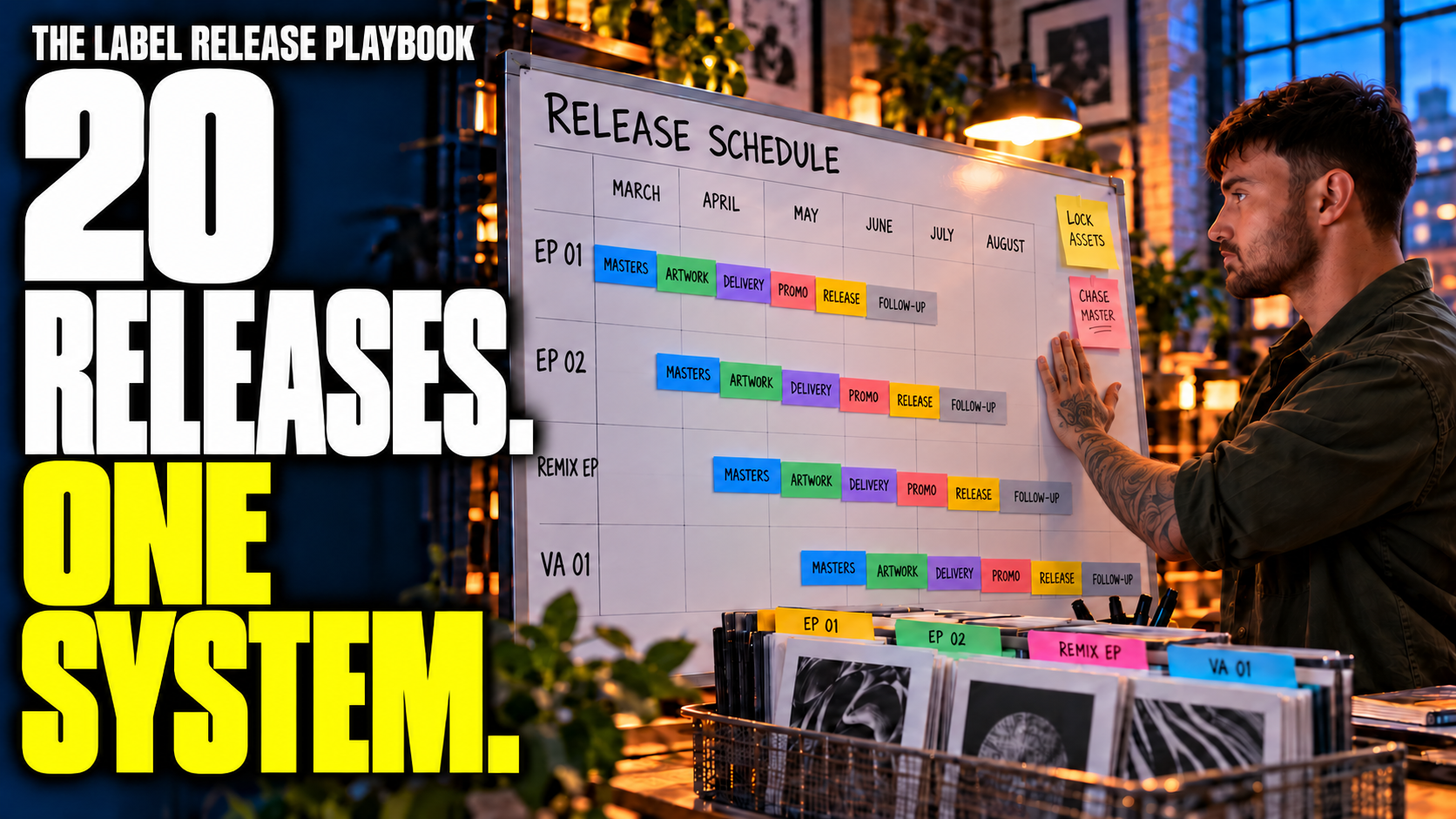
TL;DR
- Labels fail on operations, not A&R: releases collide, promo goes out late, and the catalogue earns nothing after week two.
- Your release calendar is the label's operating system. Space releases to the same audience 3 to 4 weeks apart, the same artist 6 to 8 weeks, and never announce two in one week.
- Twenty a year only works if consecutive records hit different pockets of your audience. One kind of record for one crowd belongs nearer 10 to 14, and is usually better for it.
- Every release runs the same rails: roughly 15 steps, asset lock at T-8 weeks to a week-one review at T+2. Quality stops depending on memory.
- Automate the repeatable: announce emails, reminder sequences, promo chasers. Keep the pitch and the relationships human.
- Work the catalogue like an asset: anniversaries, refreshed smart links and bundles keep old records earning.
- Measure every release against your own rolling average, and write one retro note. Twenty releases, twenty improvements.
The problem: labels fail on operations, not A&R
The promo goes out nine days before release, so the DJs who might have played the record hear it after everyone else. And the record you were proudest of in March has not been mentioned by anyone since April.
Every one of those is an operations problem. The machine around your records is held together with memory, goodwill and a group chat, and that is completely fixable.
The maths makes it urgent. Streaming makes up roughly two thirds of global recorded music revenue (IFPI), and commonly reported per-stream payouts run at roughly $0.003 to $0.005, about 200 to 333 streams to earn a single dollar. No service publishes those rates, and they move with territory and deal. No single release saves a label at these rates. Volume, consistency and a working catalogue do, and volume without a system is just faster mediocrity.
The eight-point self-audit
Tick what describes your last three releases. Most labels are doing at least four.
- You schedule by when the master arrives, not by what the calendar can hold. The calendar is a queue, not a plan.
- You compete with yourself. Your own announce buries your own release week.
- Promo goes out too late to matter. Five days before release is a courtesy, not a campaign.
- Artwork and assets have no lock date. Every downstream deadline slips, and the content plan collapses into "post the cover again".
- Every release is planned from scratch. The steps live in one person's head, and get skipped the month they are busy.
- Nobody owns anything specific. "We" are doing the promo. When everyone owns a task, no one does.
- The release is over at the end of release week. No week-one push, no nudge to non-clickers, no retro note.
- The catalogue is a graveyard. Dead links, no anniversaries, no bundles, artist pages that stopped being true a year ago.
Score out of eight:
- 0 to 2, on rails. Use the templates below so it survives a holiday, a hire or a busy month.
- 3 to 5, leaking. Normal, and expensive. Fix the spacing rules and the 15 steps before your next release.
- 6 to 8, do fewer releases. It is the fastest fix here, and the only one you can do today.
Why listen to us
We build SoundOps, the platform independent labels, promoters and artists use to run release campaigns, promo servicing and fan marketing. So we watch campaigns from the inside every week: which timelines hold, where promo quietly fails, which labels compound. The winners just run a boring, repeatable system. Everything below works with a spreadsheet and a calendar. We only remove the duct tape.
One caveat: the spacing rules, promo lead times and announce windows here are practitioner rules of thumb rather than published research. Your own rolling average (Part 6) should overrule them inside a year.
Part 1: the calendar is the operating system
The short answer: plan the year first, slot releases into it second, then work every deadline backwards from the release date. Your calendar decides what a release date is allowed to be. Most labels run it as a list of dates that happened to them.
How far apart should a record label space releases?
As a rule of thumb, leave at least 3 to 4 weeks between frontline releases aimed at the same audience, and 6 to 8 weeks between releases by the same artist, ideally with the second building on the first.
The silent killer is self-competition: two of your own releases fighting for the same fans in the same window. Your schedule reaches them as a feed, and when two records land in the same fortnight, one loses.
Two more rules for the calendar:
- Never announce two releases in the same week, even to different audiences. Announce moments are your scarcest resource.
- A 20-release year is a release roughly every 2.5 weeks. That only works if consecutive releases hit different pockets of your audience.
What is an audience pocket, and why does it decide your release count?
A pocket is the part of your audience that turns up for a particular kind of record: the dancefloor pocket, the headphones pocket, the VA and remix pocket. Pockets are not genres. Most labels that call themselves single-genre have two or three they have never named.
Pockets are what make a release every 2.5 weeks survivable: alternate them and two club records still land five weeks apart. Name yours before you book a date: the spacing rule applies within a pocket, not across the label.
If you only make one kind of record, the count comes down. Being one dancefloor deep is a legitimate choice: fans trust the logo precisely because every record sounds like the label. With no alternation doing the spacing work, 3 to 4 weeks caps you at roughly 13 to 17 a year, before anyone takes a holiday. In practice a single-pocket label lands nearer 10 to 14, and is usually better for it.
A sub-label only counts if it has its own audience. Spun up to squeeze in more releases, it is the same fans, the same volume, extra admin.
How do seasons change a release calendar?
Q4 is crowded, January is quiet, and a smart calendar exploits both. In Q4 you compete with major-label campaigns, holiday noise and seasonal pressing queues. January and February are commonly the quietest release months, and DJs come out of December hunting fresh material. So hold Q4 for catalogue pushes, gift-ready bundles and one flagship you can defend. Open the year with the records that need room.
Vinyl lead times set your floor. Confirm test pressings before you announce a date in public: announcing before the plant confirms is how "out 14 March" becomes an apology post.
Work backwards from the release date
Every deadline is the release date minus something. Pick the date, then walk backwards locking each dependency: masters, artwork, distribution delivery against your distributor's lead times, promo while DJs still have time to use it, announce when there is something for fans to do.
If a locked date slips, the release date moves or the scope shrinks. Never the silent third option, where the timeline holds and quality pays. Write it where the team can see it: dates move or scope shrinks, quality is not the buffer.
Part 2: the per-release template
The short answer: every release runs the same roughly 15-step checklist, with one named owner per step. A release is a repeatable operation with a creative payload. The payload changes. The rails never do.
The 15 steps, from asset lock to week-one review
- Asset lock is the date after which the master audio, artwork, credits and metadata cannot change. The first domino, and the one most labels skip.
- Metadata sheet complete - titles, versions, ISRC/UPC, splits, territories, writer splits registered with PRS. One owner.
- Distribution delivered - on your distributor's lead times. Their job, yours to check it happened.
- Smart links built - one for announce, one for release day. A smart link is one URL showing a fan every place to listen or buy, ordered by region, while you keep the click data.
- Promo campaign prepared - private streams or downloads, tiered A/B/C by who actually supports you (Part 3).
- Promo sent - DJs, radio and press, weeks out, not days. The step labels get wrong most often.
- Announce assets built - copy, crops, clips, press shot selects, built before announce day, not on it.
- Announce day - post, email, artist reposts, pre-order or countdown page live. One moment, one owner.
- Content calendar filled to T+1 - gaps you can see are fixable, gaps you meet live are not.
- Pre-release capture live - your own page with email or SMS capture, pre-order buttons, and the platforms' pre-saves if you qualify. Nothing warns you when you do not: a Spotify Countdown Page needs a distributor-delivered, new, original EP or album of more than one track, plus at least 3,000 monthly active listeners (not the monthly listener figure on the artist's profile); an Apple Music pre-add needs a distributor-delivered iTunes pre-order with at least one instant-gratification track. A standalone single can use neither, so on two-track club singles your own page and list are the whole mechanism.
- Promo chaser sent - one follow-up to the people with no sign of a listen. One. More trains your list to ignore you.
- Release day runbook executed - link live, blast out, socials, supporters thanked, every store link checked.
- Week-one push - second content wave, a nudge to openers who never clicked, radio and playlist follow-through, proof of support collected while it is fresh.
- Pages updated - artist page, discography, shop, true within a week of every release.
- Week-one review - numbers against your rolling average, one retro note, assets archived for the next campaign (Part 6).
Shortcut: SoundOps has a spreadsheet-style task board with Grid, Kanban and Timeline views, @mentions and due-date reminders, and a Files column you can add for the actual assets. Save this checklist once as a task template, and every new release starts as one task carrying the same 15-item checklist; you set its owner and due date for each release, and while it is open the reminders fire from there, in the app by default.
The fill-in-the-blanks release timeline (T-8 weeks to T+2)
Copy it per release. T is release day. Owner boxes take names, never teams.
The whole system is on this page. The PDF adds a year planner with the spacing rules built in, the T-8 to T+2 timeline and the 15 steps as fill-in pages for each release, a handover sheet, and the rolling-average review.
Release: ______________ Artist: ______________ Cat no: ______ Release date (T): ______________
| When | What must be true | Owner | Done |
|---|---|---|---|
| T-8 weeks | Asset lock: master, artwork, credits, ISRCs | ______ | ☐ |
| T-7 weeks | Metadata complete, delivered to distributor | ______ | ☐ |
| T-6 weeks | Smart links built; promo prepared and tiered | ______ | ☐ |
| T-5 weeks | Promo out; premiere conversations started | ______ | ☐ |
| T-4 weeks | Chaser to anyone with no sign of a listen (3 to 7 days after the send); announce assets locked; content calendar to T+1 | ______ | ☐ |
| T-3 weeks | Announce day: post, email, pre-order or countdown live | ______ | ☐ |
| T-2 weeks | Content drip running; stock confirmed | ______ | ☐ |
| T-1 week | Follow-ups done; release-day sends scheduled | ______ | ☐ |
| T (release week) | Runbook: links live, blast sent, stores checked, supporters thanked | ______ | ☐ |
| T+1 week | Week-one push; non-clicker nudge; proof of support | ______ | ☐ |
| T+2 weeks | Review vs rolling average; retro note; pages updated | ______ | ☐ |
One rule: a step without an owner is hoped for, not planned.
And if you cannot run the template, do fewer releases. Ten on rails beat twenty on vibes. Mediocre launches teach your audience, your DJs and your artists to expect less of your name.
Part 3: automation is leverage, not a replacement
The short answer: templatise anything a robot does identically every time, and protect anything where a human noticing something is the whole value. Labels hand-write the same announce email 20 times a year, then blast an identical promo pitch to 300 people who can each tell it is a blast.
Templatise these:
- Announce emails. The scaffolding never changes: the record, why it matters, what to do now.
- Release-day blasts and reminders. "Out now", "you saved this, it's live", a nudge to non-clickers, scheduled the week before release.
- Event-style triggers. A fan joining the list, buying the record or clicking a pre-order fires the next message.
The DMA's 2026 tracker of UK marketers puts email at around £41 returned per £1 spent, and your list is yours. Median Instagram engagement is 0.30% of followers per post, down from 0.36% the year before (Rival IQ 2026). Automate the channel that compounds.
Keep these human, always:
- The pitch. Written for that person, referencing what they actually play. Templated, it is worth less than nothing.
- The relationships. Thank-yous for real support, the check-in with no ask attached.
- Judgement calls. Which record gets the bigger push, which date moves, who gets the exclusive.
Promo servicing is the structured sending of pre-release music to DJs, radio and press for feedback and support, as distinct from marketing to fans. Tier it (A get it first and personally, B on the main send, C on audition), track who streamed, downloaded and replied, and chase the ones with no sign of a listen, once. A B tier that never plays anything is a number you tell yourself.
Match the channel to the tier
The tiers are a budget as well as a send order.
- Everyone: email. Nothing per recipient, so the announce, release day and week-one nudge go to the lot.
- A tier only: SMS or WhatsApp. Real money per message, buying a lock screen rather than an inbox line, so save it for the promo drop and release morning.
- Nobody: a text that could have waited. The fastest way to lose a number you cannot win back.
No open rates here, deliberately: SMS has no open tracking and Meta publishes none for WhatsApp, so every "over 90%" you have read is an assertion. Measure your own replies.
Shortcut: SoundOps carries both layers. Campaigns and automations across email, SMS, WhatsApp and Instagram handle the templated sends, with a visual automation builder for the triggers. Promo servicing runs on the same calendar: private streaming, download and feedback tracking, A/B/C recipient tiers that shape send order, and a one-click auto-chaser capped at one per campaign, so you cannot even accidentally nag.
Part 4: the team layer
The short answer: named owners per step, statuses everyone can see, handovers that survive a holiday. In a three-person label every person is a single point of failure, which is why small labels need this most.
Who owns what. Owners go on steps, not job titles. "Anna does promo" is a vibe. "Anna owns promo send for CAT042 by 14 March" is a plan. Exactly one person should be embarrassed if a step slips.
Statuses everyone can see. Could the label owner vanish for a fortnight, and could anyone else say what is due this week and who owns it?
Handovers that survive holidays. Assets live on the release in the shared system, never in a downloads folder or a DM, so the checklist is the handover. Settle promo-list access in January, not the week someone leaves.
Shortcut: a handover takes fifteen minutes when the board already holds the answers. In SoundOps the masters and artwork sit in a Files column on the release's task (add one to the board), due-date reminders go to the owner of any open task with a due date, in the app by default, and an @mention pulls the right person into a step without a call. Thirteen permission scopes mean you can hand someone the content calendar without handing them the promo list, and a task linked to a promo campaign shows them "Linked promo campaign (hidden)" rather than its name.
Part 5: the catalogue layer
The short answer: a release enters the catalogue at T+2, and the catalogue is an asset to work rather than an archive to store. Catalogue (as against frontline) is everything you have already released: already paid for, already proven, and growing with every record. The highest-margin marketing you can do.
Four repeatable plays:
- Anniversary content. One year, five, ten since a record that mattered, with zero new production. Put your ten best sellers' anniversaries in the calendar now, with owners, exactly like releases.
- Refreshed smart links on old releases. Links rot as stores change and services appear. Sweep the catalogue twice a year and watch the clicks: an old record suddenly moving (a sync, a viral clip, a big DJ rinsing it) is a signal to pounce on.
- Back-catalogue bundles. Label starter packs, artist discographies, catalogue paired with a new release. Vinyl has grown for nearly two decades straight in the US (RIAA), so catalogue vinyl in the basket raises order value with stock you already own.
- Pages that stay true. An out-of-date artist page or bio is a fan or a booker bouncing off stale information, silently.
By year three it is a quiet engine: anniversaries fill the January quiet, bundles lift every Q4, old links catch fans who arrive late. An unmaintained catalogue just depreciates.
Shortcut: SoundOps runs smart links with analytics, QR codes and geo-routing across the whole catalogue, not just the new release, so the twice-yearly sweep is a review rather than a rebuild, and a catalogue record waking up shows in the same dashboard as your frontline campaign.
Part 6: the review
The short answer: measure every release against your own rolling average, and write one retro note per release. Twenty minutes at T+2, and it is the difference between running twenty releases and learning twenty times.
Your week one against a major's is theatre. Your own last six to eight releases are the only benchmark that is both honest and available, and they answer the question that matters: is the machine improving? Keep a row per release: week-one streams, smart link clicks, email opens and clicks, promo feedback, units sold, list growth. Recent rows average out to par.
Then, three questions.
- Above or below par, and where? Name the number that diverged. Promo opens fine but clicks poor points at the record or the pitch. The average turns a feeling into a location.
- What actually happened? One paragraph. The premiere that landed, the artwork that was late, the announce that clashed.
- What is the one thing we change next release? One. A retro with seven action items produces none. Write it into the template where the next release will trip over it: "promo at T-5 not T-3".
Reading the numbers: where the release actually failed
A release is a funnel that fails at exactly one join. Find the first row that matches your numbers and stop. The fix is usually upstream of where the number looked bad.
| What you see | What it actually means | What to change next release |
|---|---|---|
| Promo opens below par | Stale list, or a sender name that means nothing. Nobody has judged the record yet. | Prune the B tier. Send from a person, not the label address. Artist name in the subject. |
| Opens fine, feedback below par | They listened and said nothing. Wrong tier, or you asked nothing answerable. | Ask one answerable thing ("playing it?"). A tier silent twice is the wrong tier. |
| Announce opens fine, clicks below par | They read it, agreed, closed it. Nothing to do. | Never announce without a pre-order, countdown or reminder capture. Step 10 exists for this. |
| Clicks above par, units below | They arrived and did not buy. Blame the offer, the price or the landing. Often a link routing badly on a phone. | Open your own smart link on your own phone. Check the physical was listed before release day. |
| Everything at par, streams below | The campaign worked. Your audience is the size it is, the one row here that is not operations. | Change the reach: collaborations, a remix that borrows another audience. |
| Week one at par, month two flat | You ran a launch. Nothing carried the record once the announce stopped. | Part 5. Bundle it, and diarise its first anniversary now. |
| List growth near zero | You rented the attention and gave it back. | Capture on the countdown page, the smart link and the shop receipt. |
That is the loop: calendar, template, automation, team, catalogue, review. One system, run twenty times, improving as it goes.
Where SoundOps fits
You can run all of this on a spreadsheet, a calendar, a mail tool and discipline. Plenty of labels do, across five subscriptions and a lot of copy-paste. SoundOps is the one place the whole OS runs:
- The template layer: a task board in Grid, Kanban or Timeline view, your 15 steps saved as a template that starts each release as one task with the same checklist, an owner and due date you set per release, due-date reminders (in the app by default), and the master and artwork in a Files column you add to the board.
- The automation layer: campaigns and automations across email, SMS, WhatsApp and Instagram, with a visual builder and scheduled sends.
- The promo layer: private streaming with feedback tracking, A/B/C tiers, the capped auto-chaser, and forensic watermarking with leak tracing on Business plans and above. Promo recipients are metered separately from marketing email.
- The catalogue layer: smart links with analytics, QR codes and geo-routing across your whole back catalogue, plus a shop selling vinyl, merch and digital through your own Stripe account. The money lands with you.
- The team layer: 13 permission scopes, so the intern sees the content calendar and not the promo list, and the task board hides the name of any linked record their role can't open.
And where it doesn't, so you can plan around it:
- We don't distribute your music. Step 3 just confirms your distributor got it away on time.
- We don't master, and we don't make artwork. Asset lock is a deadline we hold you to.
- We don't collect your royalties. PPL and PRS carry on exactly as they do now.
- We can't make a DJ play the record. Promo servicing gets it there early and tells you who opened it. The pitch is yours.
Plans start at £19/month, every core feature on every plan (only usage limits and a few pro extras differ), a platform fee on sales of 1% to 2.5% by plan, and a 14-day free trial on Starter with a 14-day money-back guarantee on your first subscription payment. Every step here works without us. The system is the point. We just made it one login.
The condensed checklist
Screenshot this. It is the whole playbook.
Calendar rules (set once a year)
- ☐ 3 to 4 weeks minimum between releases to the same audience
- ☐ 6 to 8 weeks minimum between releases by the same artist
- ☐ Never two announces in the same week
- ☐ Q4 for catalogue pushes, bundles and one defensible flagship
- ☐ January and February held for records that need room
- ☐ Physical dates set only after pressing timelines are confirmed
- ☐ Anniversaries of your ten best sellers diarised, with owners
Per release (the rails, T-8 to T+2)
- ☐ T-8 asset lock, T-7 metadata and distribution, T-6 smart links and promo prepared
- ☐ T-5 promo out, T-4 one chaser plus announce assets and content calendar
- ☐ T-3 announce, T-2 stock confirmed, T-1 sends scheduled, T runbook, T+1 push, T+2 review
Standing rules
- ☐ Every step has one named owner
- ☐ Dates move or scope shrinks; quality is never the buffer
- ☐ Templatise the emails, reminders and chasers; hand-write pitches and thank-yous
- ☐ Statuses visible to the whole team without asking
- ☐ Catalogue link sweep twice a year
Frequently asked questions
How far apart should a record label space releases?
As a rule of thumb, at least 3 to 4 weeks between frontline releases aimed at the same audience, and 6 to 8 weeks between releases by the same artist. Each release needs its own clean announce moment, release week and tail, without a sibling release fighting it for the same fans.
How long before release should a label send promo?
Around 4 to 6 weeks before release for club DJs, and 6 to 8 weeks or more for radio, with a single chaser to anyone with no sign of a listen 3 to 7 days after the send. DJs and radio need time to work a record into sets and shows; promo that arrives days before release is a courtesy, not a campaign.
When should a label announce a release?
Roughly 3 weeks before release for a single or EP, longer for an album campaign, and only when there is something for a fan to do: a pre-order, a countdown page, a pre-add, or a way to be reminded on release day.
What should be in a release planning template?
Around 15 repeatable steps from asset lock to week-one review: assets, metadata, distribution delivery, smart links, promo, announce, content calendar, pre-release capture, one chaser, a release-day runbook, a week-one push, page updates and a review against your rolling average. Each step gets a date worked back from the release date and one named owner.
How many releases a year should an independent label do?
As many as it can run through the full template without skipping steps, and no more. Ten releases on a system beat twenty on improvisation, because every under-supported launch spends audience trust. Twenty a year only works if consecutive releases hit different pockets of the audience: a label making one kind of record for one crowd is at roughly 13 to 17 at the absolute ceiling, and lands nearer 10 to 14 in practice. Scale the count only after the template runs clean at the current pace.
Is Q4 a bad time to release music?
It is a crowded time: major campaigns, holiday noise and longer vinyl pressing queues all work against a frontline release landing cleanly. Many independent labels do better using Q4 for catalogue bundles and gift-ready physical, then releasing into the quieter January and February window.
Do Spotify pre-saves still work for independent labels?
Yes. Established tools such as Feature.fm, Linkfire and Hypeddit still offer them, on extended API access granted before the requirements tightened: since May 2025 that access has needed a registered business with 250,000 monthly active users, which nothing new can clear. Two things did change for everyone. A fan's authorisation now expires after six months, so the "forever" pre-save is gone, and the fan authorises the tool rather than your label. Capture you own does the same two jobs, day-one activity and captured intent, and does not lapse: a pre-release page with email or SMS capture, pre-order buttons, and a reminder that fires automatically once the record is live.
Can a label use a Spotify Countdown Page or Apple Music pre-add for a single?
Neither. A Countdown Page needs a new, original EP or album with more than one track, delivered through a distributor, plus at least 3,000 monthly active listeners (not the monthly listener figure on the artist's profile) and Admin or Editor access in Spotify for Artists. Apple Music pre-add needs a distributor-delivered iTunes pre-order with at least one instant-gratification track. Rereleases, deluxe editions, remasters and compilations are out of both. For a catalogue of two-track club singles neither mechanic is available, so the pre-release capture has to be your own page and your own list.
What should a label measure after release week?
Week-one numbers against the label's own rolling average across the last 6 to 8 releases: streams if tracked, smart link clicks, email opens and clicks, promo open and feedback rates, units sold and list growth. Your own average shows whether the machine is improving. End with exactly one retro note.
What is promo servicing?
Promo servicing is the structured sending of pre-release music to DJs, radio and press for feedback and support, as distinct from marketing to fans. Done properly it is tiered (best supporters first), tracked (who opened, played and rated), chased exactly once, and timed weeks ahead of release so supporters can actually use the music.
Know someone who needs this?
Send them the playbook. It is free to read, no signup needed.